[Z985.Ebook] Download PDF Killing for Coal: America's Deadliest Labor War, by Thomas G. Andrews
Download PDF Killing for Coal: America's Deadliest Labor War, by Thomas G. Andrews
Be the initial that are reading this Killing For Coal: America's Deadliest Labor War, By Thomas G. Andrews Based on some reasons, reading this e-book will certainly offer more benefits. Also you need to read it step by step, web page by page, you can complete it whenever and anywhere you have time. As soon as much more, this on-line book Killing For Coal: America's Deadliest Labor War, By Thomas G. Andrews will certainly offer you very easy of reviewing time and task. It additionally offers the experience that is cost effective to get to and also acquire significantly for better life.
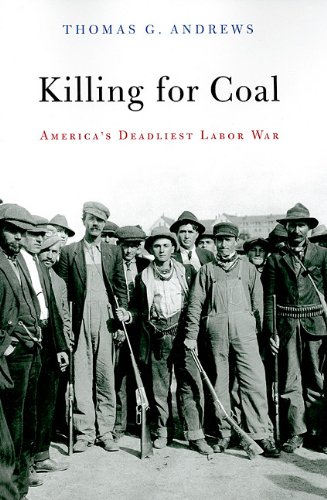
Killing for Coal: America's Deadliest Labor War, by Thomas G. Andrews

Download PDF Killing for Coal: America's Deadliest Labor War, by Thomas G. Andrews
Killing For Coal: America's Deadliest Labor War, By Thomas G. Andrews Exactly how an easy concept by reading can boost you to be an effective person? Checking out Killing For Coal: America's Deadliest Labor War, By Thomas G. Andrews is an extremely simple task. But, just how can many individuals be so careless to review? They will like to invest their spare time to talking or hanging around. When actually, reading Killing For Coal: America's Deadliest Labor War, By Thomas G. Andrews will provide you more opportunities to be effective finished with the hard works.
The factor of why you could get and get this Killing For Coal: America's Deadliest Labor War, By Thomas G. Andrews earlier is that this is guide in soft file form. You could check out the books Killing For Coal: America's Deadliest Labor War, By Thomas G. Andrews wherever you really want even you are in the bus, office, house, and also various other locations. Yet, you could not need to relocate or bring the book Killing For Coal: America's Deadliest Labor War, By Thomas G. Andrews print any place you go. So, you will not have larger bag to lug. This is why your option making better principle of reading Killing For Coal: America's Deadliest Labor War, By Thomas G. Andrews is really practical from this instance.
Understanding the method the best ways to get this book Killing For Coal: America's Deadliest Labor War, By Thomas G. Andrews is likewise important. You have been in ideal website to start getting this info. Get the Killing For Coal: America's Deadliest Labor War, By Thomas G. Andrews web link that we supply here and also see the web link. You can purchase guide Killing For Coal: America's Deadliest Labor War, By Thomas G. Andrews or get it when feasible. You can quickly download this Killing For Coal: America's Deadliest Labor War, By Thomas G. Andrews after getting offer. So, when you need guide rapidly, you can directly get it. It's so simple and so fats, isn't it? You should prefer to by doing this.
Simply connect your device computer or gizmo to the internet linking. Obtain the modern technology to make your downloading and install Killing For Coal: America's Deadliest Labor War, By Thomas G. Andrews finished. Also you don't wish to check out, you could directly shut the book soft documents and also open Killing For Coal: America's Deadliest Labor War, By Thomas G. Andrews it later. You can also conveniently get guide all over, due to the fact that Killing For Coal: America's Deadliest Labor War, By Thomas G. Andrews it remains in your gizmo. Or when being in the workplace, this Killing For Coal: America's Deadliest Labor War, By Thomas G. Andrews is also recommended to review in your computer system tool.
On a spring morning in 1914, in the stark foothills of southern Colorado, members of the United Mine Workers of America clashed with guards employed by the Rockefeller family, and a state militia beholden to Colorado’s industrial barons. When the dust settled, nineteen men, women, and children among the miners’ families lay dead. The strikers had killed at least thirty men, destroyed six mines, and laid waste to two company towns.
Killing for Coal offers a bold and original perspective on the 1914 Ludlow Massacre and the “Great Coalfield War.” In a sweeping story of transformation that begins in the coal beds and culminates with the deadliest strike in American history, Thomas Andrews illuminates the causes and consequences of the militancy that erupted in colliers’ strikes over the course of nearly half a century. He reveals a complex world shaped by the connected forces of land, labor, corporate industrialization, and workers’ resistance.
Brilliantly conceived and written, this book takes the organic world as its starting point. The resulting elucidation of the coalfield wars goes far beyond traditional labor history. Considering issues of social and environmental justice in the context of an economy dependent on fossil fuel, Andrews makes a powerful case for rethinking the relationships that unite and divide workers, consumers, capitalists, and the natural world.
- Sales Rank: #125196 in Books
- Published on: 2010-09-01
- Released on: 2010-04-12
- Original language: English
- Number of items: 1
- Dimensions: 1.01" h x 6.01" w x 9.34" l, 1.01 pounds
- Binding: Paperback
- 408 pages
Review
The Ludlow Massacre of 1914 has long been known as one of the most notorious events in all of American labor history, but until the publication of Killing for Coal, it was still possible to see this slaughter simply as an episode in the history of American industrial violence. In Thomas Andrews's skilled hands, it becomes something much subtler, more complicated, and revealing: a window onto the profound transformation of work and environment that occurred on the Western mining frontier in the late nineteenth and early twentieth centuries. Anyone interested in the history of labor, the environment, and the American West will want to read this book. (William Cronon, author of Nature's Metropolis: Chicago and the Great West)
Killing for Coal is a stunning achievement. Beautifully written and masterfully researched, it stands as the definitive history of the dramatic events at Ludlow and breaks new ground in our understanding of industrialization and the environment. If I were to pick one word to describe this book, I would say, "powerful." (Kathryn Morse, author of The Nature of Gold: An Environmental History of the Klondike Gold Rush)
Killing for Coal arises from the rare and providential convergence of an extraordinary author and an extraordinary topic. With a perfect instinct for the telling detail, Thomas Andrews wields a matching talent for conveying, in crystal-clear prose, the deepest meanings of history. This is, in every sense, an illuminating book, shining light into a dark terrain of the American past and of the human soul. (Patricia Nelson Limerick, author of The Legacy of Conquest: The Unbroken Past of the American West)
A groundbreaking work about coal and coal development, labor relations and class conflict. (Sandra Dallas Denver Post 2009-02-15)
Thomas G. Andrews' Killing for Coal offers an intriguing analysis of the so-called Ludlow Massacre of April 20, 1914, a watershed event in American labor history that he illuminates with a new understanding of the complexity of this conflict...Killing for Coal distinguishes itself from conventional labor histories, by going beyond sociological factors to look at the total physical environment--what Andrews calls the "workscape"--and the role it played in the lives of both labor and management...In its deft marriage of natural and social history, Killing for Coal sets a new standard for how the history of industry can and should be written. (Emily F. Popek PopMatters 2009-01-30)
A stunning debut, full of insight into the role of labor and class not just in southern Colorado, but across the country. (Denver Westword 2009-03-27)
Andrews brings a 21st-century approach to this once-troubled landscape where the region's voracious need for fuel trumped the rights and independence of the men who dragged it out of the ground. (Bob Hoover Pittsburgh Post-Gazette 2009-04-19)
Killing for Coal is far more than a blow-by-blow account of America's deadliest labor war. It is an environmental history that seeks to explain strike violence as the natural excretion of an industry that brutalized the earth and the men who worked beneath it. Andrews is one of the excellent young scholars who have given new life to the field of labor and working-class studies by introducing new questions about race and gender, ethnicity and nationality, and new insights drawn from anthropology and physical geography...Andrews deserves credit for writing one of the best books ever published on the mining industry and its environmental impact and for drawing more public attention to the Ludlow story and its significance. (James Green Dissent 2009-05-01)
Andrews does an excellent job of placing the massacre in the larger context of both previous labor strife in the area and the violent reprisals that armed bands of miners launched on mine owners, strikebreakers, and militia men in response to the deaths at Ludlow. One of the great strengths of Andrews's account is his integration of environmental history into his narrative at all levels, and not just as an afterthought. The book is as much a history of coal, coal mining, and the reshaping of Colorado's environment as it is a history of the Great Coalfield War of 1914. (A. M. Berkowitz Choice 2009-04-01)
About the Author
Thomas G. Andrews is Associate Professor of History at the University of Colorado Boulder.
Most helpful customer reviews
3 of 3 people found the following review helpful.
An ambitious, over-the-top history that I nonetheless found worthwhile
By R. M. Peterson
Most "massacre" sites in the Great Plains are from the campaigns to remove the Indians. One exception is the Ludlow Massacre site, just off I-25 between the Colorado cities of Trinidad and Pueblo, snug against the foothills of the Rocky Mountains. There, the "massacre" occurred during a labor war -- "America's Deadliest Labor War" -- between coal miners and coal mine operators (of which the largest was owned by the Rockefellers). Ludlow was a tent city erected by the United Mine Workers union to house miners and their families after they had been evicted from company towns for going out on strike. On April 20, 1914, Colorado National Guardsmen (most of whom had only recently been guards for the mining companies) surrounded the Ludlow tent city. There is no consensus about what started the shooting, but by day's end there were nineteen dead -- one militiaman and eighteen coal miners and family members, including two women and eleven children. That touched off a ten-day "war", in which miners went on a destructive rampage, killing and attacking mines and company towns. The fighting stopped when President Wilson sent in Federal troops. The strike itself ended when the UMW ran out of money. All told, from the beginning of the strike in September 1913 to its end in December 1914, the death toll was between seventy-five and one hundred.
KILLING FOR COAL starts and concludes with the Ludlow Massacre. In between, the book is about coal and coal mining in Colorado and about the larger conflict between labor and capital. It aims to be an environmental history and an industrial history. It aims to explore the natural world and the social, technological, and economic forces that combined to bring about the Colorado Coal War that culminated in the Ludlow Massacre. It also aims to be a new and different sort of history, and as things turned out, it was awarded the Bancroft Prize in 2009.
In the end I am somewhat ambivalent about the book. I had wanted to read about the Ludlow Massacre, and I selected KILLING FOR COAL because I thought it would provide more background than the other options. I got plenty of background -- more than I hoped for -- and I wish that there had been more detailed discussion of the Ludlow Massacre and the ten days of guerilla warfare that followed it. Nonetheless, there is considerable merit in what Thomas Andrews was trying to do in writing a broader, more comprehensive history. At times, the scope of his vision and the reach of his ambition were nigh breathtaking. Plus, Andrews is a much more colorful and skilled writer than most historians. The problem is that he overdoes things on virtually all scores.
On occasion, he claims too much. (The book "illuminates how the close study of one small area of the world can improve our understanding of processes that now pose grave threats to the well-being of our nation and our planet.") In trying to cover everything, he sometimes dwells on the obvious. ("Miners sidled up to the bars of [mine camp saloons] thirsting not simply for refreshment, but also for release from the anxiety, loneliness, and anger that mine work tended to inflict on them.") There are occasional gratuitous nods to political correctitude. (Andrews uses the pronoun "he" for a "mogul" buying coal to heat his Denver mansion, because "virtually all moguls were men".) Often Andrews gets carried away with the color and flamboyance of his prose. ("Men, women, and children had traveled a long, winding road to reach this precipice; many years of struggle and suffering seemed to drive them toward the abyss before them.") There are sentences that are goofy ("They [historical photographs of Colorado] attest to the protean nature of energy and its incredible capacity for disguise."), and others that are grandiose ("[Mining] companies unwittingly transformed disputes rooted in subterranean workscapes into an all-out struggle in which the very meaning and fate of America seemed to hang in the balance.").
The book is based on seemingly prodigious research and reading. Andrews gets considerable mileage out of the transcripts of a lengthy "man-to-man talk" the Colorado governor called between three coal company executives and three leaders of the striking miners in November 1913, transcripts inexplicably ignored by other historians. The 290 pages of text are supported by 75 pages of endnotes. There are about thirty historical photographs and four maps, all of which enhance the presentation.
Bottom line: KILLING FOR COAL is an ambitious, over-the-top history that nonetheless is worth reading if you are interested in (a) the history of coal mining and the coal industry in America, (b) the conflict between capital and labor as played out in the coal fields of Colorado, or even (c) the Ludlow Massacre.
2 of 2 people found the following review helpful.
A Fascinating Read...
By Matthew W. Quinn
KILLING FOR COAL is a fascinating look into a part of American history that's really not well-known. It starts out with a fascinating description of how the Colorado coal fields formed millions of years ago and continues on by describing how the mining of coal revolutionized the lives of the people living in the energy-poor and hostile West, although this came at an environmental price. It also does a great job describing the lives and culture of the miners and what led to the titular strike and violence.
However, the latter part of the book doesn't live up to the promise of the prologue. The prologue discusses how the unrest spread from the miners into other sectors of the working class and how it looked like the strikers might take over the state, but that isn't really covered in the section covering the battles between the strikers and the guardsmen after the Ludlow Massacre. The battles aren't covered in great detail either. Finally, although the prologue discusses the trials of the strike organizers afterward and how various factors (including anti-Communism and even a period of dominance by the Klan) "encouraged" the miners to forget how they'd outright defeated the state government, there is almost nothing about the aftermath. Considering how well-done the early parts of the book are, this is a major missed opportunity.
Still, it's a very informative book and definitely worth a read.
0 of 0 people found the following review helpful.
The first half of the book was very dry and ...
By Jerry Smart
The first half of the book was very dry and not very interesting. The title was a bit conceiving. I thought they would talk more about the miners. The last half of the book was interesting as the writer wrote about the actual miners and their struggles with the gready companies.
Killing for Coal: America's Deadliest Labor War, by Thomas G. Andrews PDF
Killing for Coal: America's Deadliest Labor War, by Thomas G. Andrews EPub
Killing for Coal: America's Deadliest Labor War, by Thomas G. Andrews Doc
Killing for Coal: America's Deadliest Labor War, by Thomas G. Andrews iBooks
Killing for Coal: America's Deadliest Labor War, by Thomas G. Andrews rtf
Killing for Coal: America's Deadliest Labor War, by Thomas G. Andrews Mobipocket
Killing for Coal: America's Deadliest Labor War, by Thomas G. Andrews Kindle
0 komentar